.png)








Salary growth update: APAC & EMEA
2026 is shaping up to be an interesting year for salary developments and compensation structures. While European member states are preparing for the EU Pay Directive to ensure more equitable pay, other parts of the globe are also noting considerable changes in salary growth over time.
Inflation is cooling in parts of APAC, offering some cost relief, yet the talent shortages continue to pressure workforce strategies. Employers are no longer just reacting to volatility, they're making data-led pay decisions to lock in critical skills.
For European pay, real wages rose in 23 of 25 countries in 2025, and growth will pick up in 2026, but trends differ widely by market. Eastern Europe leads the West, minimum wages rise double digits in several EU countries and pay transparency rules change how companies set pay. This article explores where salaries are rising, where salaries are stabilising, and what these shifts mean for employers across key APAC and European markets.
What is salary growth?
Salary growth, sometimes referred to as wage growth or a salary increase, is the increase in an employee’s earnings over time and is often driven by geopolitical and socioeconomic factors. While individual salary increases are determined by each employer and can differ across sectors, overall salary growth within a specific region provides key insight into the talent market, including what employees may expect and what employers are willing to pay.
How salary growth can impact talent decisions
Salary growth plays a significant role in how employers make talent decisions across markets. Salary expectations and skills scarcity is reshaping behaviour for both employers and job seekers.
1. It shapes whether people stay or leave
When salary growth does not keep pace with market realities, such as inflation or rising skill demand, employees are more likely to seek new opportunities. Companies with stagnant pay can often experience greater attrition as people look for better pay and benefits.
2. Salary growth drives how candidate negotiate
As the market experiences salary growth or a decrease in real salary gains, it can impact how candidates negotiate their pay in the hiring process. Individuals are increasingly empowered with data about compensation benchmarks, strengthening their leverage during salary discussions.
3. Employer competitiveness increases
With salary changes, employers can quickly lose top talent to better-paying competitors. Salary growth is essential for attracting and retaining talent. When salary growth lags industry standards, employers lose candidates to better‑paying competitors.
4. Workforce planning is influenced
Salary growth also affects employer decisions about which roles to hire, whether to invest in upskilling, and how to balance talent costs. To more effectively plan for pay, employers must:
- Forecast what future skills will cost, not just which skills they’ll need.
- Adjust headcount plans based on predicted salary growth.
- Budget for competitive pay ahead of time.
APAC is leading global salary growth
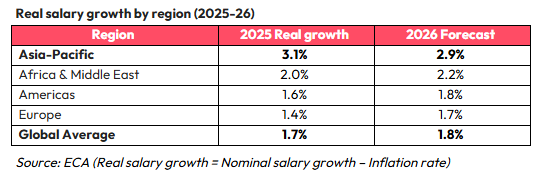
APAC continues to lead global real wage growth. In 2025, the region achieved a median real increase (above inflation) of 3.1%, far outpacing other regions like Europe at 1.4%. For 2026, real gains are expected to remain positive, though slightly moderated in some areas due to rising inflation in emerging markets.
Nominal salary increase budgets across APAC are projected at around 5.2% for 2026, up slightly from 5.1% in 2025. This reflects strategic focus on talent retention in competitive sectors like tech, digital, and engineering.
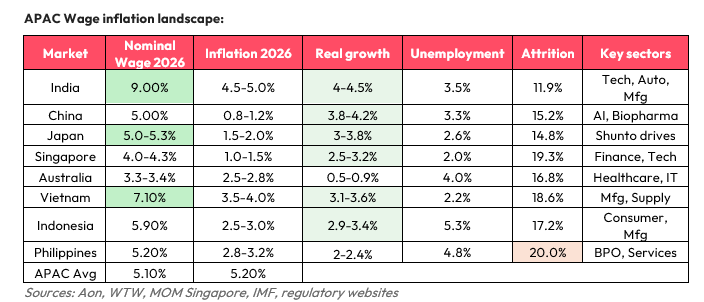
The APAC wage landscape in 2026 reveals a three-tier structure driven by economic maturity, inflation pressures, and talent competition
Salary growth market analysis
India: sustained high growth amid structural transformation
India maintains its position as APAC’s wage growth leader with a projected 9% increase in 2026, down marginally from 9.5% in 2025. This sustained momentum is driven by robust GDP growth forecasted at 6.6% and continued demand for technology, digital, and engineering talent. The country’s emergence as a global digital and AI hub is creating wage premiums in specialised roles, with tech and product development sectors experiencing the highest increases.
Real wage growth remains modest due to persistent inflation. While nominal wages have increased 8.5% or more annually since 2021, workers have struggled with high food costs and commodity prices. The wage growth narrative is increasingly about skill transition, workers moving from informal, low-skilled roles to formal sector positions, rather than individual salary escalation.
Singapore: Real wage recovery and progressive policies
Singapore projects a 4.0-4.3% salary increase for 2026, maintaining stability from 2025’s 4.1%. More significantly, the city-state has achieved meaningful real wage growth, with median household income rising 6.8% in inflation-adjusted terms in 2025. Per-capita household income jumped 7.5% in real terms, reflecting both wage growth outpacing inflation and government rebates.
The Progressive Wage Model (PWM) continues to reshape Singapore’s wage structure, with the lowest paid 20% seeing real wage growth of 5.9% over five years versus 3.6% for median workers. This deliberate compression of wage inequality through policy intervention has created upward pressure on entry-level and mid-tier positions in healthcare, logistics, and hospitality sectors.
Mainland China: Reaching the 5% threshold amid structural challenges
Mainland China’s projected 5% salary increase for 2026 marks the first time the country has reached this level in recent years, up from 4.3% in 2025. However, this growth occurs against a backdrop of economic headwinds including weak consumer demand, property sector challenges, and subdued labour market conditions.
Wage growth varies significantly by sector. Biopharma, life sciences, and technology sectors, particularly AI-related roles are experiencing robust increases of 6-8%. Manufacturing and traditional services lag at 3-4%. Real wage growth remains constrained by persistent producer price deflation and low consumer inflation hovering around 0.7%, creating limited pricing power for employers.
Vietnam and Indonesia: High-growth corridors
Vietnam’s 7.1% projected increase and Indonesia’s 5.9% reflect their roles as manufacturing and services hubs benefiting from China-plus-one strategies. Both markets face talent scarcity in specialised roles, driving wage premiums for bilingual professionals, supply chain specialists, and technical managers. Vietnam’s consistency at 7% growth for multiple years signals structural demand rather than cyclical pressure.
Sectoral wage hotspots and talent premiums
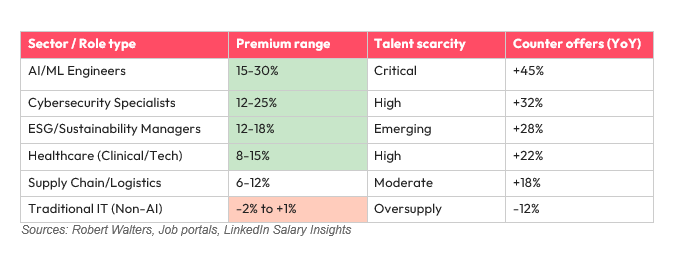
Wage pressure is acute in innovation-intensive sectors. AI/ML engineers command 15-30% premiums over baseline roles, with counter-offer activity up 45% year-over-year. Singapore’s tech sector reports 8-10% bilingual premiums for Japanese/Mandarin speakers. ESG and green energy roles see 12-18% premiums in Mainland China and Australia as decarbonisation mandates accelerate hiring.
Key takeaways for employers
- Across several APAC markets, salary increases are moderating while inflation remains elevated, compressing real income gains. Employers should move beyond broad annual increments and introduce targeted adjustments or flexible payouts to protect retention without permanently inflating fixed costs.
- Employee expectations now extend beyond salary to flexibility, wellbeing and career progression. Organizations that strengthen benefits, hybrid policies and learning pathways can moderate wage escalation while sustaining engagement.
- In an environment of tightening wage budgets, companies that actively benchmark salaries against industry peers and monitor attrition trends can avoid both overpaying and losing key talent
- AI, digital and specialist finance roles are commanding outsized increases relative to generalist functions. Employers should rely on salary benchmarking and internal skills mapping to allocate budgets toward business-critical capabilities instead of applying blanket wage hikes.
Real wages are recovering in Europe
After years of inflation eroding purchasing power, European workers are finally seeing real wage growth return. The Employment Conditions Abroad (ECA) 2025-26 salary trends survey, covering 200 multinational companies across 25 European countries, confirms a broad-based recovery, real salaries rose in 23 of 25 surveyed countries in 2025, with a median real wage gain of 1.4%. looking ahead, ECA projects median real wage growth of 1.7% across Europe in 2026.
This is structurally significant. Real wages in the EU area had been severely impacted by the 2022-23 inflation shock. By early 2025 they had largely returned to pre-spike levels, an important milestone for household confidence and, critically, for the talent market dynamics that staffing and hiring teams must navigate. The ECB confirms that nominal wages in the eurozone grew faster than prices through most of 2025, a trend expected to strengthen in 2026.
Eastern Europe leads again, and the gap Is widening
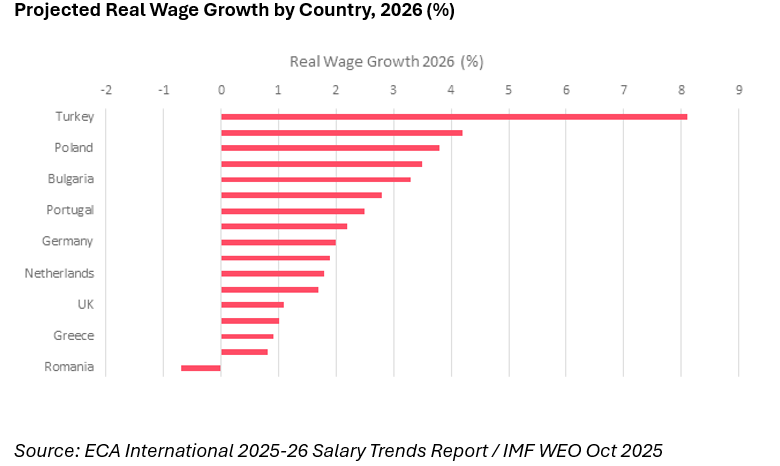
Hungary, Poland, Czechia, and Bulgaria are forecast to be Europe's fastest growing salary markets in 2026. The ECA report is clear that Eastern European economies are forecast to outperform their Western European peers, benefiting from faster economic growth and higher productivity. This pattern reflects structural dynamics that run deeper than just wage catch up.
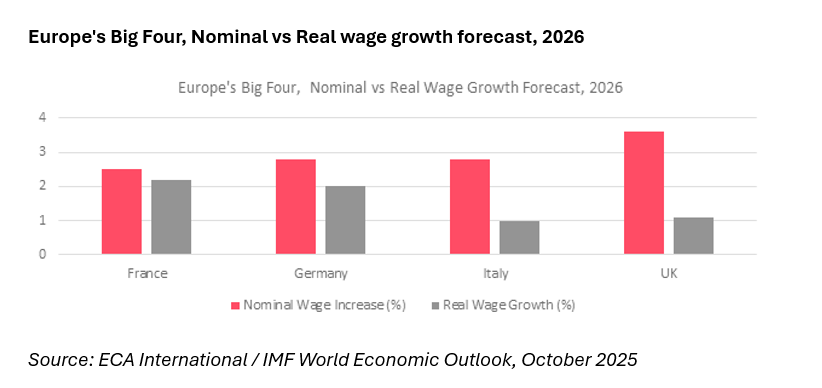
Among the major western economies, France leads with the highest real wage growth, followed by Germany, Italy, and the UK. The UK, with a nominal salary increase of 3.6%, the highest in the big four markets, will see real wage growth of approximately 1.1% once inflation is accounted for, representing the lowest real gain in the group. Turkey remains the statistical outlier, projected real wage growth of 8.1% in 2026 reflects workers recovering purchasing power lost during years of wages running below inflation, with nominal gains projected at 40% offset by persistently elevated inflation of 34.9%.
East vs West: A tale of two salary markets
Eastern Europe
- Increases range between +6-8%.
- Average nominal salary increased in tech roles.
- Wage increases are driven by faster GDP growth, tighter domestic labour markets, risign productivty, and sustained foreign direct investment (FDI) into Poland, Czechia, Hungary, and Bulgaria.
Western Europe
- Increases range between +3-5%.
- Nominal increases are constrained by sluggish productivity growth, tight fiscal conditions, and employer caution.
Minimum wages 2026
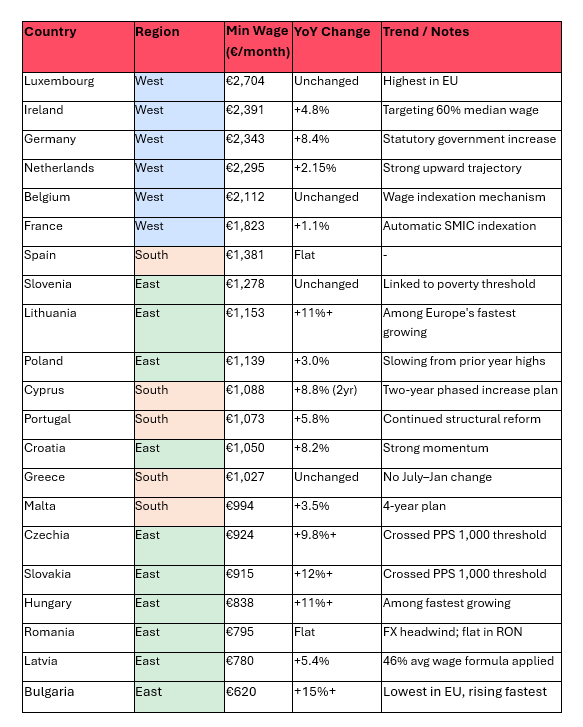
As of 1 January 2026, 22 of 27 EU member states have a statutory minimum wage. Five countries, including Denmark, Italy, Austria, Finland, and Sweden rely entirely on collective bargaining. Italy has seen renewed parliamentary debate in 2025 about introducing a statutory minimum. The highest-lowest gap across the EU now spans more than 4× in euro terms.
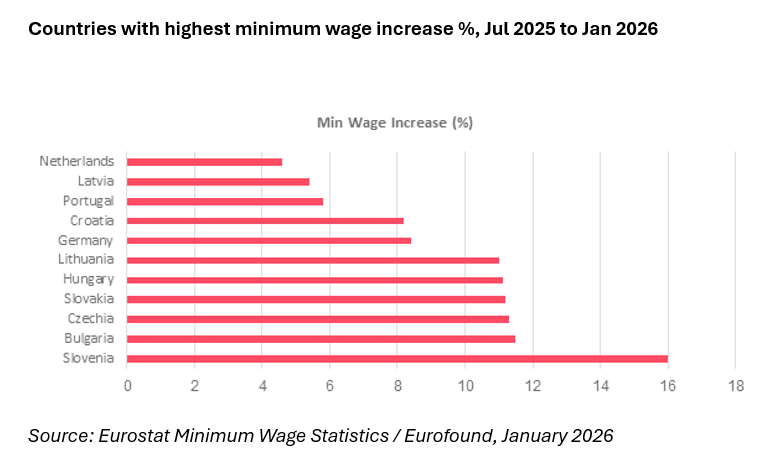
Bulgaria, Hungary, Lithuania, Slovakia, and Czechia recorded the most aggressive increases, all rising by more than 11% between July 2025 and January 2026. This reflects active application of the EU Minimum Wage Directive (2022/2041), which requires member states to target 60% of gross median wage. Slovenia saw the single largest percentage increase at 16%, driven by its poverty-threshold linkage formula.
What this means for hiring strategies in 2026
Here is what the 2026 European salary landscape demands from hiring managers, talent acquisition leads, and workforce strategists.
- Benchmark with granularity: A single European salary benchmark is no longer sufficient. The Netherlands is seeing 6.3% tech increases while Spain remains at 4.0%. Benchmark separately by country and increasingly by city. Remote work partially levelled markets, but local cost-of-living expectations are reasserting.
- Urgent review for Eastern Europe structures: With Bulgaria, Hungary, Slovakia, and Czechia all seeing a 11% minimum wage rises and strong real wage growth forecasts, Eastern European salary structures need comprehensive review. What was competitive 18 months ago is now at entry level or even in some cases, below standard.
- Build total reward propositions: In markets where salary increases are constrained at 4-5%, the total reward package is the competitive lever. Learning budgets, equity, flexible working, enhanced leave, and purpose-driven culture increasingly differentiate employers. Quantify and communicate this.
- Prepare for pay transparency compliance: The EU Pay transparency directive means salary ranges must appear in job postings. This requires internal pay benchmarking to be done properly before roles are advertised. Organisations that do this well will gain a recruitment advantage.
Conclusion
APAC's real salary growth in 2026 will settle into a structurally elevated but stable range of 5.1–5.2% across formal sectors, outpacing cooling inflation of 2–3% to deliver consistent real wage gains of 2–3% region-wide. Eastern Europe is outpacing the West, nominal salary increases of 6–8% across Poland, Hungary, Czechia, and Bulgaria, compared to 3–5% in Western Europe. Slovenia, Bulgaria, Hungary, Slovakia, and Czechia all recorded 11%+ increases between July 2025 and January 2026, driven by the EU minimum wage directive. Pay transparency laws, rising expectations, and fast-shifting markets mean employers need a full strategy reset, not just an annual salary review.
For employers, success lies in strategic allocation, prioritising critical skills, blending total rewards and rethinking location mixes through offshoring, while employees must leverage skills and market data to capture their share of this positive real wage environment.
Related content
View All
What will drive hiring success this year? While salary benchmarking often takes center stage when looking to hire new talent, the growing importance of comprehensive benefits packages can often be overlooked. 44% of employees would actually consider accepting a lower salary if the role offered attra
Read More
Over the last few years, there’s been significant shifts in the workplace. From increased tech adoption to the way employers hire, they all serve as a clear signal that the way we work and approach our jobs is changing. For employers, there’s an increased focus on training and support to really get
Read MoreFAQs
-
What is the average salary growth rate?
The average salary growth rate refers to the typical yearly increase in employee earnings, usually influenced by inflation, economic conditions, and evolving market demands. It reflects how organisations adjust pay to stay competitive, reward performance, and retain talent.
While the exact rate varies across industries, regions, and by job experience, salary growth generally represents steady, incremental increases rather than dramatic changes. Overall, it helps ensure that compensation keeps pace with living costs and the value employees bring to their roles. -
What information is included in a Robert Walters compensation benchmarking report?
Each benchmarking report provides a clear summary and detailed analysis of your organisation’s pay structures compared to market standards. Every report is tailored to your specific brief and typically includes market salary and benefits data; skills and position comparisons; competitor data; and insights segmented by industry, region, and company size to ensure relevance to your business.
Importantly, our reports include tailored advice on how to optimise your compensation strategy to overcome any market challenges, such as inflation, while improving your competitiveness.
-
Which roles can I benchmark within my organisation?
Compensation benchmarking can be applied to most roles for which there is market data, from manager level to C-suite executives. Benchmarking is particularly valuable for roles that are difficult to fill, rapidly evolving, or critical to your strategic goals.
For organisations with unique or hybrid roles, we provide tailored benchmarking by identifying comparable positions across the industry to ensure you’re aligning pay and benefits appropriately, even in niche areas.
-
Can you help me align my compensation strategy with industry trends?
Yes, salary benchmarking doesn’t just provide data—it informs strategy. We help you align your pay and benefits practices with emerging trends, such as the increasing emphasis on performance-based pay, flexible benefits, and equity or incentive structures.
By understanding market dynamics and employee expectations, we guide you in creating a compensation strategy that positions your organisation as an employer of choice, while supporting your long-term business goals.